
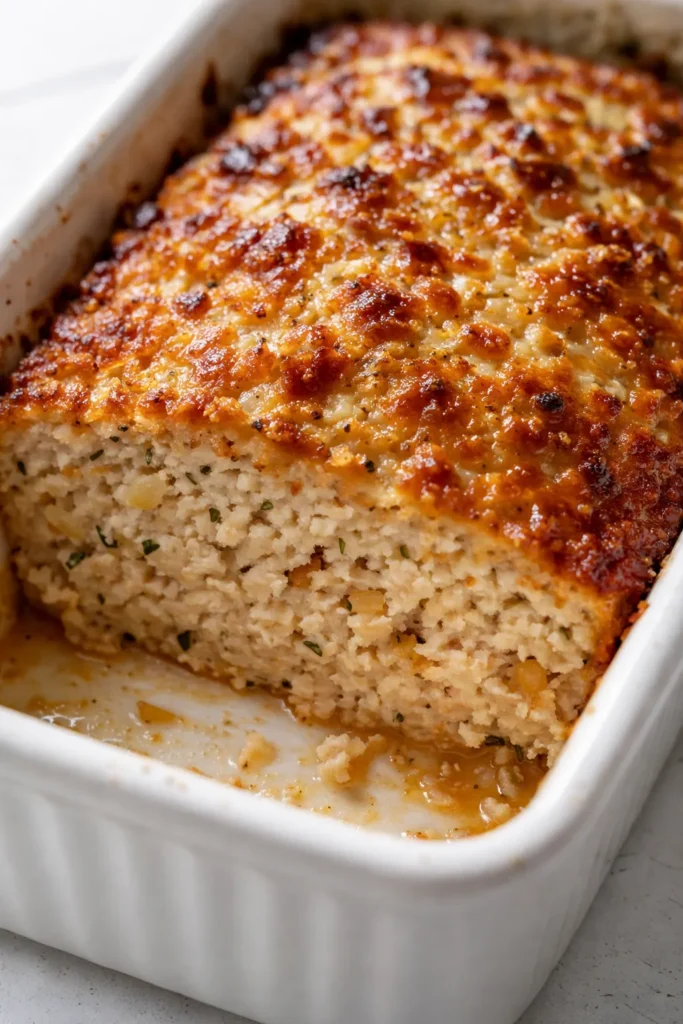
I’ve made a lot of dry chicken meatloaf in my life. A lot. The kind that crumbles into sad, flavorless bits on the plate. The kind that made my kids look at me with that “Mom, can we have spaghetti instead?” face. This version? Completely different story. The first time I made it, my husband asked, “Wait — this is chicken?” and then went back for thirds.
The short version: A tender, garlicky meatloaf that stays moist thanks to Parmesan and a few tricks I learned the hard way. Ready in about 55 minutes.
I’ve made this about once every two weeks for the past year, tweaking the ratio of breadcrumbs to cheese and testing the difference between fresh and jarred garlic. My pickiest eater — the one who claims to “not like meatloaf” — now asks for it by name on Monday nights.
- Serves: 6 as a main dish
- Hands-On Time: 20 min | Total Time: 55 min
- Difficulty: Easy enough for a Tuesday night
- Cost per serving: ~$2.40
- Calories: ~310 per serving (with glaze)
- Dietary Notes: Naturally low-carb if you swap breadcrumbs for almond flour
(Photo above: overhead shot of the finished meatloaf on a white platter, sliced into thick pieces with the glazed top catching the light, a small bowl of extra ketchup glaze on the side, and fresh parsley scattered across a wooden cutting board. Warm kitchen lighting from a nearby window.)
Why This One Actually Turns Out Juicy (And Doesn’t Taste Like Diet Food)
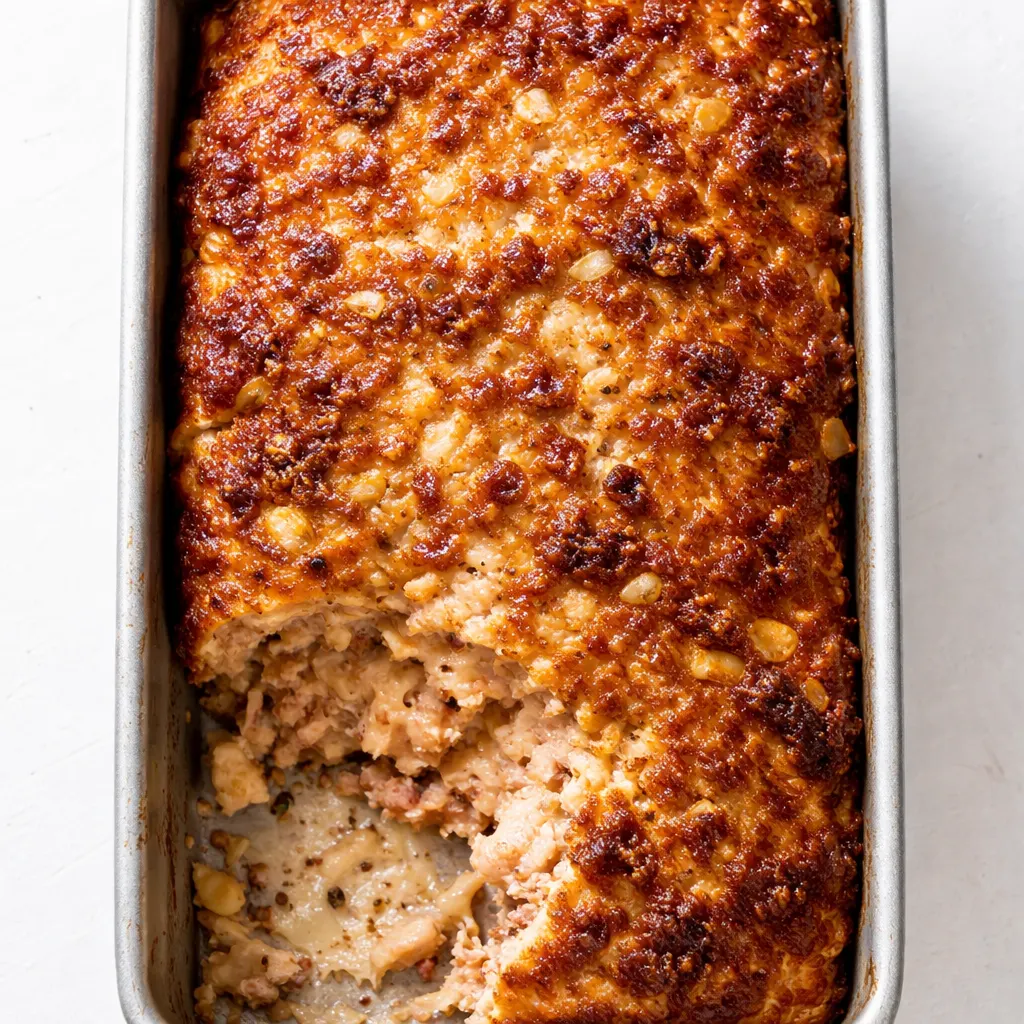
Chicken meatloaf has a bad reputation for being dry and flavorless because most recipes either use lean ground chicken breast or skip the fat entirely. That’s a mistake. Ground chicken thigh — or a mix of thigh and breast — gives you the moisture you need without feeling heavy. I use a 70/30 mix of breast to thigh in my grocery store’s ground chicken, and it works perfectly.
The second trick is a panade — a paste of breadcrumbs and milk that gets mixed in before anything else. This isn’t my invention; it’s an old-school method that keeps the meat tender by trapping moisture as it cooks. Marta used it in her beef meatballs. I use it here. It makes an undeniable difference.
The Parmesan isn’t just for flavor — though it brings that salty, nutty depth that makes the whole thing taste richer than it is. The cheese also helps bind the loaf and adds a little fat that keeps everything from drying out in the oven. Three ingredients doing three jobs each. That’s the kind of cooking I love.
Everything You Need (And a Few Notes From Me)
- 2 lbs ground chicken: Look for a blend of breast and thigh if you can find it. If all you have is breast meat, add 2 tablespoons of olive oil to the mix — it helps.
My grocery store labels theirs “ground chicken” and it’s usually a mix. Ask at the meat counter if you’re not sure. - 1 cup freshly grated Parmesan: Please don’t use the green can stuff. Pre-grated Parmesan has anti-caking agents that mess with the texture. Grate it yourself from a block — it takes two minutes and the flavor is completely different.
My kids actually prefer the taste of freshly grated. They notice when I sneak in the jarred stuff. Kids are honest like that. - 1/2 cup plain breadcrumbs: Panko works too. Italian-seasoned breadcrumbs will change the flavor profile — use them if that sounds good, but cut the salt in the recipe slightly.
- 1/3 cup milk: Whole milk works best. I’ve used 2% and it was fine. I wouldn’t use skim — it’s not rich enough to make a proper panade.
- 4 cloves garlic, minced: Freshly minced, not from a jar. Jarred garlic has a sharp, almost metallic taste when baked. Fresh garlic mellows into something sweet and savory.
I’ve tested both. The jarred version left a weird aftertaste in the final loaf. Fresh is worth the extra 30 seconds of chopping. - 1 large egg: Acts as a binder. If you’re out, 2 tablespoons of mayonnaise works — seriously, it adds moisture and keeps things tender.
- 1 teaspoon salt: I use kosher salt. If you’re using table salt, cut back to 3/4 teaspoon.
- 1/2 teaspoon black pepper: Freshly ground if you can.
- 1/2 teaspoon dried Italian seasoning: Oregano, basil, thyme — whatever blend you have. I’ve also used just dried oregano alone and it was lovely.
- 1/2 cup ketchup (for glaze): I use a simpler ketchup — no high-fructose corn syrup if I can help it. The glaze is sweet and tangy and caramelizes beautifully on top.
- 1 tablespoon brown sugar (for glaze): Light or dark — both work. Dark gives a deeper molasses note.
- 1/2 teaspoon garlic powder (for glaze): Not the same as minced garlic. Garlic powder dissolves into the ketchup and creates a smooth, even glaze.
What to Pull Out Before You Start
- A large mixing bowl — not too wide, you want to be able to mix without flinging meat everywhere
- Loaf pan (9×5-inch) or a rimmed baking sheet if you prefer a free-form loaf
- Measuring cups and spoons
- A microplane or box grater for the Parmesan
- Small bowl for the glaze
- Rubber spatula or clean hands for mixing
I prefer a loaf pan for this recipe because it keeps the loaf tall and evenly shaped, which helps with even cooking. A baking sheet works too — the loaf will be flatter and cook a little faster, so start checking at 40 minutes.
Let’s Make It (Step by Step)
I promise this comes together faster than you think. Most of the time is oven time, so you can clean up the kitchen or start a side dish while it bakes.
Preheat and prep: Set your oven to 375°F. If you’re using a loaf pan, give it a light spray of cooking oil or a smear of butter.
- Make the panade: In your large mixing bowl, combine the breadcrumbs and milk. Stir them together with a fork until it forms a thick, wet paste. Let it sit for 2 minutes — this gives the breadcrumbs time to fully absorb the milk.
(📸 Photo tip: You should see a thick, oatmeal-like paste that holds its shape when you push it with the fork. If it’s too dry, add another tablespoon of milk.) - Add the flavor base: Add the grated Parmesan, minced garlic, egg, salt, pepper, and Italian seasoning to the panade. Stir until everything is evenly combined. It’ll look like a chunky, fragrant paste — that’s exactly right.
- Add the chicken: Add the ground chicken to the bowl. Use your hands or a rubber spatula to gently mix everything together. The key word is gently — overmixing makes the meatloaf dense and tough. Mix just until no streaks of raw chicken remain and everything looks uniform.
This is the step where I always think, “Is it mixed enough?” and then I remind myself: better under-mixed than overworked. A few small streaks of breadcrumb mixture are fine. - Shape the loaf: Transfer the mixture to your prepared loaf pan. Press it in gently — don’t pack it down hard — and smooth the top with the back of a spoon or a spatula. If you’re going free-form on a baking sheet, shape it into a loaf about 8 inches long and 4 inches wide, with slightly rounded edges.
- Make the glaze: In a small bowl, stir together the ketchup, brown sugar, and garlic powder until the sugar dissolves. It should be smooth and a little glossy.
(📸 Photo tip: The finished glaze should be a deep reddish-brown, slightly thinner than straight ketchup, and smell faintly sweet and garlicky.) - Glaze and bake: Spread about half the glaze evenly over the top of the meatloaf. Reserve the rest for later. Bake at 375°F for 30 minutes.
- Glaze again and finish: After 30 minutes, remove the loaf from the oven carefully — tilt the pan and pour off any accumulated liquid if there’s a lot (this keeps the glaze from getting watery). Spread the remaining glaze on top. Return to the oven and bake for another 15–20 minutes, until the internal temperature reaches 165°F when measured at the center with an instant-read thermometer.
- Rest before slicing: Let the meatloaf rest in the pan for 10 minutes. This is not optional — slicing too early lets all the juices run out onto the cutting board instead of staying in the meat. After 10 minutes, transfer to a cutting board or platter, slice into thick pieces, and serve.
How I Meal Prep These for the Week
This recipe is my Sunday night secret weapon. I make a double batch — one for Monday dinner and one to slice for lunch sandwiches all week. The leftovers are honestly better the next day once the flavors have settled.
- Fridge: Store sliced or whole in an airtight container for up to 4 days. To reheat, wrap in foil and warm in a 350°F oven for 10 minutes, or microwave for 45 seconds. The microwave works but the oven keeps the glaze sticky and nice.
- Freezer: Yes! Bake the meatloaf completely, let it cool, wrap tightly in plastic wrap then foil, and freeze for up to 3 months. Thaw overnight in the fridge. Reheat in a 350°F oven for 15–20 minutes.
- Reheat: Oven is best. If you’re in a hurry, the microwave works — just expect the glaze to soften a bit. I sometimes add a fresh swipe of ketchup glaze after reheating to bring back that glossy look.
Things I Wish I’d Known the First Time
- Don’t skip the panade rest time. Those 2 minutes where the breadcrumbs sit in the milk aren’t wasted time. They’re what makes the texture tender instead of dense. I know it seems like nothing, but I’ve tested it side by side — the version without the rest was noticeably drier.
- Check the temperature in the center, not the edge. I once pulled my meatloaf early because the edges read 170°F, but the middle was still 150°F. Learned that lesson the hard way. Insert the thermometer into the thickest middle part of the loaf.
- Let it rest — I mean it. I’ve made this probably 30 times now, and every time I’m tempted to slice into it right away because it smells so good. Every time I force myself to wait. The 10-minute rest is what keeps those beautiful slices intact instead of falling apart on the plate.
- Pressing a little indent in the top before baking. This might sound weird, but it helps the glaze pool on top rather than run off the sides. Just a shallow well along the center, about 1/2 inch deep. Even if you skip it, the loaf will still be good — I’ve done both.
- Even if you overmix a little, it’s still delicious. This is the truth: the first version I made was overmixed and slightly dense. My family still ate the whole thing and asked when I’d make it again. Don’t stress about being perfect — stress about getting dinner on the table.
Swaps That Actually Work
- Dairy-free: Use nutritional yeast instead of Parmesan (about 1/3 cup) and unsweetened almond milk or oat milk for the panade. The flavor changes slightly — the yeast gives a different kind of savory — but my dairy-free sister-in-law genuinely loved it.
- Gluten-free: Swap the breadcrumbs for gluten-free panko or almond flour. If using almond flour, reduce the milk to 2 tablespoons since it absorbs more liquid. I’ve tried both and prefer the gluten-free panko for texture.
- Spicy version: Add 1/2 teaspoon of red pepper flakes or a minced jalapeño (seeds removed) to the mix. I do this for the grown-up version when it’s just us after my kids go to bed.
- Turkey version: Use ground turkey instead of chicken — same method, same timing. Ground turkey is slightly leaner, so consider adding a tablespoon of olive oil to the mix.
- Air fryer version: Shape into a smaller loaf (about 6×3 inches) and bake at 360°F for 25–30 minutes. Check internal temp at 25 minutes — air fryers run hot.
Questions I Get About This Recipe All the Time
Q: Why did my meatloaf turn out dry?
A: I’ve been there more times than I want to admit. Two most likely culprits: you used all breast meat (thigh is your friend) or you overbaked it. Chicken meatloaf dries out fast once it passes 170°F. That’s why I recommend pulling it at exactly 165°F and letting carry-over cooking do the rest. Next time, try the mix of breast and thigh and check your oven temp with an oven thermometer — mine runs 25 degrees hot and I had to adjust.
Q: Can I make this without a loaf pan?
A: Absolutely. A rimmed baking sheet works great for a free-form loaf — just shape it with your hands and it’ll cook a bit faster. Start checking the temp at 40 minutes. I’ve also made it in a cast iron skillet shaped into a round “loaf” and it came out beautifully browned on the sides.
Q: How long does this last in the fridge? Can I freeze it?
A: In the fridge, it stays good for 4 days in an airtight container. For freezing, I recommend baking it fully first, letting it cool completely, then wrapping it tight in plastic wrap and foil — it’ll keep for 3 months. Reheat in a 350°F oven wrapped in foil for about 15 minutes. The microwave works in a pinch but the oven brings back that glaze texture.
Q: What do you serve with this?
A: In our house, it’s almost always mashed potatoes — the gravy situation is too good to pass up. But I also love it with roasted broccoli (the garlic in the meatloaf pairs perfectly) or a simple green salad with lemon vinaigrette to cut through the richness. My kids actually ask for buttered egg noodles on the side, and honestly, that’s a solid choice too.
More Recipes My Family Makes on Repeat
If this one worked for you, here are a few others that get the same reaction at our table:
- Classic Beef Meatloaf with a Brown Sugar Glaze — The one that started it all — even more traditional, equally forgiving
- Sheet Pan Garlic Parmesan Chicken and Veggies — Same garlic-Parmesan energy in a 30-minute weeknight meal
- Tuna Noodle Casserole (the One My Kids Actually Eat) — Another weeknight hero that’s creamy, comforting, and kid-approved
This meatloaf has become one of those recipes I can make without thinking — the kind where I know the feel of the panade, the smell when the garlic hits the mixture, the exact color the glaze turns when it’s perfectly caramelized. I hope it becomes that for you, too.
If you try it, come back and leave a comment — I genuinely love hearing how it goes, especially from people who thought they didn’t like chicken meatloaf. Tag me on Pinterest so I can see your version!
📌 This juicy garlic Parmesan chicken meatloaf recipe stays tender even after reheating — save it for your next busy weeknight dinner or meal prep Sunday.
Garlic Parmesan Chicken Meatloaf That’s Actually Juicy — Ready in Under an Hour
Equipment
- Large Mixing Bowl
- Loaf pan (9×5-inch) or rimmed baking sheet
- Measuring Cups and Spoons
- Microplane or box grater
- Small bowl for glaze
- Rubber spatula or clean hands
- Instant-read thermometer
Ingredients
- 1/2 cup plain breadcrumbs (or panko)
- 1/3 cup milk (whole milk preferred)
- 1 cup freshly grated Parmesan cheese
- 4 cloves garlic, minced
- 1 large egg
- 1 teaspoon kosher salt
- 1/2 teaspoon black pepper, freshly ground
- 1/2 teaspoon dried Italian seasoning
- 2 lbs ground chicken (mix of breast and thigh)
Glaze
- 1/2 cup ketchup
- 1 tablespoon brown sugar (light or dark)
- 1/2 teaspoon garlic powder
Instructions
- Preheat the oven to 375°F. Lightly grease a 9×5-inch loaf pan with cooking spray or butter.
- Make the panade: In a large mixing bowl, combine the breadcrumbs and milk. Stir with a fork until it forms a thick paste. Let sit for 2 minutes.
- Add the Parmesan, minced garlic, egg, salt, pepper, and Italian seasoning to the panade. Stir until evenly combined (it will look like a chunky paste).
- Add the ground chicken to the bowl. Using your hands or a rubber spatula, gently mix just until no streaks remain. Do not overmix.
- Transfer the mixture to the prepared loaf pan. Press gently to shape, smoothing the top with a spoon. (For a free-form loaf on a baking sheet, shape into an 8×4-inch loaf.)
- Make the glaze: In a small bowl, stir together ketchup, brown sugar, and garlic powder until smooth.
- Spread about half the glaze evenly over the top of the meatloaf. Reserve the rest.
- Bake at 375°F for 30 minutes. Remove from the oven, carefully pour off any accumulated liquid, then spread the remaining glaze on top.
- Return to the oven and bake for another 15-20 minutes, until the internal temperature reaches 165°F when measured at the center.
- Let the meatloaf rest in the pan for 10 minutes (do not skip this step). Transfer to a cutting board, slice into thick pieces, and serve.
Notes
Related posts:
 Mini Quiche Recipe: The Store-Bought Crust Version That Tastes Like You Made It From Scratch
 The Slow Cooker Cowboy Casserole That Saves Tired Weeknights (No Soggy Tots Allowed)
 Quick Lemon Ricotta Pasta for Busy Weeknights: Creamy, Bright, and on the Table in 20 Minutes
 Juicy Oven Baked Chicken Thighs That Stay Golden and Tender — in 40 Minutes
 Lemon Garlic Butter Baked Salmon in Foil That’s Ready in 25 Minutes — No Fuss, No Mess
 Lipton Onion Soup Meatloaf for Tuesday Nights: Moist, Savory, and the Only One You’ll Ever Need