
I came to this recipe sideways, the way I come to most things that aren’t German or Appalachian. A friend brought a full Korean feast to a potluck years ago — bowls of glazed beef, pickles I couldn’t stop reaching for, pancakes that vanished in seconds. But it was this little bowl of spinach, sitting off to the side in a simple white dish, that I kept coming back to. It was glossy, deeply green, and smelled like toasted nuts and something I couldn’t quite name. I asked her to show me how she made it, and she laughed. “It’s just spinach,” she said. “It’s all in how you handle it.” She was right. It’s never just spinach. It’s the way you treat it from the water to the bowl.
The short version: This comes together in 15 minutes flat and tastes like you spent an hour coaxing flavor out of every leaf. My kids eat it by the handful straight from the mixing bowl.
I’ve made this version close to thirty times now, tweaking the water content and the garlic ratio. This is the one that finally stuck — the one that makes even a Tuesday night dinner feel like a proper meal.
- Serves: 4 as a side dish
- Hands-On Time: 15 min | Total Time: 15 min
- Difficulty: Easy — just don’t walk away from the boiling water
- Cost per serving: ~$1.25
- Calories: ~60 per serving
- Dietary Notes: Naturally vegan, gluten-free (with tamari), paleo-friendly
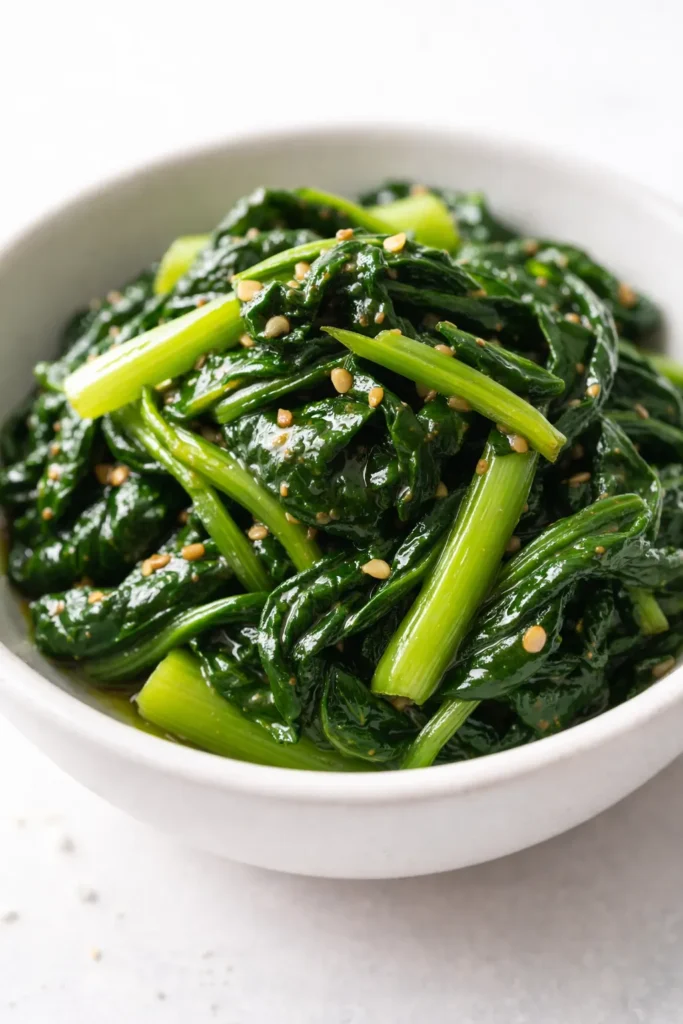
(Photo above: A shallow white bowl piled high with glossy, deep green spinach, flecked with toasted sesame seeds and a hint of minced garlic. A pair of chopsticks rests alongside. Mid-afternoon light from the west window catches the sheen of sesame oil on the leaves.)
The Trick That Changed Everything for Me
The problem with most American-style wilted or steamed spinach is that it sits in its own juice. That juice — green, watery, slightly bitter — dilutes everything you put on it. You end up with pale seasoning and a mouthfeel that reminds me of the cafeteria spinach I refused to eat in elementary school.
The Korean approach is the opposite. You blanch the spinach in heavily salted water, shock it to set the color, and then — here’s the part that matters — you squeeze it within an inch of its life. All that chlorophyll-heavy water goes down the drain instead of pooling in your serving bowl. What’s left is a concentrated, silky bundle of spinach that’s ready to drink up the sesame oil and soy sauce like a sponge.
That one step is the difference between a side dish that gets politely eaten and one that gets scraped clean. I’ve tested it both ways (and eaten the watery version too many times) so you don’t have to. The squeeze is the secret. Everything else is just assembly.
What Goes In — Plus My Honest Notes
- 1 pound fresh spinach (about 2 large bunches): Look for flat-leaf or semi-savoy spinach with crisp stems. The stems are edible, so don’t bother trimming them unless they’re woody. I’ve used bagged spinach in a pinch — it works, but the texture is slightly less sturdy. If you grow your own, even better.
- 1 ½ tablespoons soy sauce (or tamari for gluten-free): This is the main salt source, so use one you like the taste of. I tested this with low-sodium soy sauce and found myself adding an extra pinch of salt at the end. Regular soy sauce gives it the right depth without the extra step.
- 1 tablespoon toasted sesame oil: This is non-negotiable in my kitchen. Toasted sesame oil has a deep, almost smoky nuttiness that raw sesame oil doesn’t. My daughter Nora calls it “the smell of Friday night takeout” — that’s the one you want. It should be dark amber, almost mahogany, not pale yellow.
- 2 cloves garlic, finely minced (or grated on a microplane): The garlic is raw, so grate it finely or it will bite back. I let the garlic sit in the soy sauce for a minute before mixing — it takes the sharp edge off while keeping the flavor. My husband, who claims he doesn’t like raw garlic, never complains about this version.
- 1 tablespoon toasted sesame seeds (plus more for garnish): Toasting them yourself takes exactly 2 minutes and makes a world of difference. My kids will pick around untoasted seeds. Toasted? They ask for a spoon. They smell warm and nutty, like the inside of a good bakery.
- A pinch of sugar (optional, but I add it every time): Just a tiny pinch — enough to round out the salt and bitterness of the spinach. I know it’s not traditional for every Korean grandma, but my German grandmother Marta would have added a pinch of sugar to almost any vegetable. So I do too. It’s a whisper, not a statement.
What to Pull Out Before You Start
- A large pot for blanching (4 quarts is plenty)
- A slotted spoon or spider strainer
- A big bowl of ice water
- Clean kitchen towels or a fine-mesh strainer (for squeezing)
- A mixing bowl
- A small skillet (if you need to toast your sesame seeds)
That’s it. No food processor, no mandoline, no special tools. Your hands are the most important tool for the squeezing step.
Making Sigeumchi Namul — My Exact Process
This goes fast, so I highly recommend reading through once before you even turn on the water. The actual cooking time is about 90 seconds.
- Bring a pot of salted water to a rolling boil: Use about 4 quarts of water and a generous tablespoon of salt. It should taste like the sea. While you wait, set up a large bowl of ice water next to the stove.
- Wash the spinach thoroughly: Spinach hides grit in its folds. Swish it in a sink full of cold water, lift it out, and repeat if the water is sandy. Shake off the excess water, but don’t dry it completely — the water clinging to the leaves helps them cook evenly. (📸 Photo tip: The water should run clear after the second rinse. This is your sign it’s clean.)
- Blanch the spinach in batches: Add the spinach to the boiling water in big handfuls. It will look like an impossible, towering pile of leaves. Don’t panic. Use your spider strainer to gently push it under the surface. Cook for exactly 30 to 40 seconds — just long enough to wilt it and soften the stems. The smell shifts here — from raw and grassy to a sweet, concentrated greenness, like the smell of a spring garden after a rain. That’s your cue. (📸 Photo tip: The color should turn a vivid, almost jewel-tone green. This happens fast. Don’t walk away.)
- Shock the spinach in ice water: Immediately transfer the spinach to the ice water bath with your slotted spoon. This stops the cooking instantly and sets the bright color. Swish it around until it’s completely cold to the touch — about 30 seconds.
- Squeeze the spinach dry — and I mean dry: Gather the spinach into a ball and squeeze it firmly over the sink. The water that comes out should start as a steady stream. When it slows to a trickle, transfer it to a clean kitchen towel. Wrap the towel around the spinach and wring it with both hands — like a heavy wet sweater. This is the most important step in the whole recipe. A wet spinach makes a watery, diluted namul. Be firm. You’re not hurting it.
- Cut the spinach into 2-inch lengths: Lay the squeezed spinach bundle on your cutting board and cut it crosswise. This makes it easy to eat with chopsticks and ensures every bite has a mix of stem and leaf.
- Make the dressing in a big bowl: Whisk together the soy sauce, toasted sesame oil, minced garlic, and a pinch of sugar. Let the garlic sit in the soy sauce for a minute while you finish prepping. This takes the raw edge off and melds the flavors.
- Gently toss the spinach with the dressing and sesame seeds: Add the spinach and most of the sesame seeds to the bowl. Use your hands to gently separate the leaves and coat them evenly in the dressing. Work gently — you’re coating, not compressing. Your fingers can feel when every strand is separated and glossy.
- Taste and adjust: Add a few drops of sesame oil if it needs more richness, a pinch of salt if it needs more punch, or another sprinkle of seeds for texture. I always steal a strand of spinach here to check the balance. It’s the best part of being the cook.
- Serve at room temperature or cold: Mound it in a serving bowl with a final scattering of toasted sesame seeds. It’s perfect as soon as it’s made, but it gets even better as it sits.
Make-Ahead Notes — This One’s a Gift for Your Future Self
This is one of those rare recipes that actually tastes better on day two. The flavors mingle, the garlic settles down, and the spinach absorbs the sesame oil in a way that makes every bite more satisfying. I make a double batch on Sundays and pack it for lunch all week.
- Fridge: Store in an airtight container for up to 4 days. Let it come to room temperature for 10 minutes before serving, or eat it cold — both are delicious.
- Freezer: I don’t recommend freezing this one. The texture of the thawed spinach gets mushy and watery, and the whole point of this dish is its tender-but-not-soggy texture.
- Reheat: This is traditionally served at room temperature or cold. If you must have it warm, briefly microwave it in 15-second bursts, but honestly, it’s best straight from the mixing bowl at whatever temperature it lands at.
Things I Wish I’d Known the First Time
- Don’t skimp on the squeeze: I know it feels aggressive. It feels like you’re destroying something. But that water is your enemy here. The drier the spinach, the more flavor it will soak up. I’ve made this both ways — the wet version tastes like sad steamed spinach. The dry version tastes like the best thing on the table.
- Toast your own sesame seeds: It takes two minutes in a dry skillet over medium heat, shaking the pan every few seconds. They go from pale to golden to fragrant very quickly. The moment you smell them — warm and nutty — pour them onto a plate to stop the cooking. Pre-toasted seeds from the store are fine, but they don’t have that same just-toasted warmth.
- Let the garlic sit in the soy sauce: If you’ve ever bitten into a clump of raw, harsh garlic in an otherwise perfect dish, you know the pain. Giving the garlic a minute to soften in the soy sauce takes the sharp edge off without losing the punch. I learned this one the hard way after serving a batch that tasted like a garlic bomb.
- Use your hands: A spatula or spoon will clump the spinach together. Your fingers are gentler and more precise. You can feel when every strand is separated and coated. Even if you’re squeamish about touching your food (I used to be!), wash your hands well and try it. It makes a difference.
Swaps That Actually Work
- Gluten-Free: Swap the soy sauce for tamari or coconut aminos. My sister-in-law can’t do gluten, so I make this version for family dinners. It’s just as good — just use a good-quality tamari.
- No Spinach? Try other greens: This method works beautifully with watercress, kale (blanch for 60 seconds instead), or Swiss chard (use the leaves only, save the stems for another dish). My garden overflows with chard in the summer, and this is my favorite way to use it up.
- Make it spicy: Add 1/2 teaspoon of gochugaru (Korean red pepper flakes) to the dressing for a mild warmth. My husband, who puts hot sauce on everything, loves this version. It’s still perfectly delicious without, but if you have it in the pantry, give it a try.
- Kid-Friendly Mild Version: Use a little less garlic and a pinch more sugar. The sesame oil is what makes it taste familiar and “nutty” to most kids. My own two have been eating this since they could chew, and it’s never been a struggle.
Questions I Get About This Recipe All the Time
Q: Why did my spinach turn out bitter?
A: That usually means it was overcooked in the blanching step, or you used older, thick-stemmed spinach. Stick to the 30 to 40 second blanch and get it into that ice bath immediately. If the spinach is past its prime, the bitterness is built in. Fresh, tender spinach makes all the difference. You can always save an older bunch by trimming the thickest stems.
Q: Can I skip the sugar? Or use honey?
A: You can skip the sugar entirely if you prefer a strictly savory version. It will still be delicious. Honey works in a pinch, but it adds a floral note that changes the flavor profile. I prefer a neutral sweetener like a tiny pinch of white or brown sugar, or even a splash of agave. A little sweetness is traditional, but it’s your kitchen.
Q: How long does this last in the fridge, and can I freeze it?
A: It keeps beautifully in the fridge for 3 to 4 days in an airtight container. I usually eat it cold right out of the container for lunch. Freezing is not recommended — the texture will turn mushy and release water when it thaws, which defeats the whole point of the squeezing step.
Q: What do you serve with Sigeumchi Namul?
A: This is a banchan, so it’s meant to be part of a spread. I serve it alongside Korean BBQ chicken, bulgogi-style beef, or even just a simple fried rice bowl. In my house, it often ends up next to a fried egg and some kimchi for a quick lunch. It’s also incredible as a topping for savory oatmeal or tucked into a rice bowl with avocado and pickled radish. My kids love it as a “salad” with their grilled fish.
More Recipes My Family Makes on Repeat
If you liked this one, here are a few others that get the same reaction at our table:
- Quick Kimchi Fried Rice — The one I make when there’s leftover rice and a restless appetite.
- Gochujang Glazed Chicken Thighs — Sweet, spicy, and roasted to crispy perfection. Pairs perfectly with this spinach.
- Easy Cucumber Kimchi (Oi Muchim) — Another quick banchan that’s crunchy, refreshing, and comes together in 10 minutes.
This little bowl of spinach has become a staple in our rotation, the same way Marta’s green beans were every summer. It’s humble, it’s fast, and it reminds me that the best cooking isn’t about complicated techniques — it’s about paying attention to the details that matter. The squeeze. The toasting. The moment you let the garlic settle into the soy sauce. Those small, quiet steps are what turn a handful of leaves into something you’ll remember.
If you make it, I’d love to hear how it goes. Drop a comment below and tell me what you served it with — I’m always looking for new combinations.
📌 Pin this 15-minute Korean spinach side dish recipe for your next banchan spread — it’s the simple, sesame-scented side that makes every meal feel like a feast.
Korean Spinach Side Dish (Sigeumchi Namul)
Equipment
- Large Pot
- Slotted Spoon
- Bowl of Ice Water
- Clean Kitchen Towel
- Mixing Bowl
- Small Skillet (optional for toasting seeds)
Ingredients
- 1 pound fresh spinach (about 2 large bunches)
- 1.5 tablespoons soy sauce (or tamari)
- 1 tablespoon toasted sesame oil
- 2 cloves garlic, finely minced
- 1 tablespoon toasted sesame seeds (plus more for garnish)
- 1 pinch sugar (optional)
Instructions
- Bring a pot of salted water to a rolling boil. Use about 4 quarts of water and a generous tablespoon of salt. It should taste like the sea. While you wait, set up a large bowl of ice water next to the stove.
- Wash the spinach thoroughly. Spinach hides grit in its folds. Swish it in a sink full of cold water, lift it out, and repeat if the water is sandy. Shake off the excess water, but don’t dry it completely – the water clinging to the leaves helps them cook evenly.
- Blanch the spinach in batches: Add the spinach to the boiling water in big handfuls. Use your spider strainer to gently push it under the surface. Cook for exactly 30 to 40 seconds – just long enough to wilt it and soften the stems. The smell shifts from raw and grassy to a sweet, concentrated greenness.
- Shock the spinach in ice water: Immediately transfer the spinach to the ice water bath with your slotted spoon. Swish it around until it’s completely cold to the touch – about 30 seconds.
- Squeeze the spinach dry – and I mean dry: Gather the spinach into a ball and squeeze it firmly over the sink. The water that comes out should start as a steady stream. When it slows to a trickle, transfer it to a clean kitchen towel. Wrap the towel around the spinach and wring it with both hands – like a heavy wet sweater. This is the most important step.
- Cut the spinach into 2-inch lengths: Lay the squeezed spinach bundle on your cutting board and cut it crosswise. This makes it easy to eat with chopsticks and ensures every bite has a mix of stem and leaf.
- Make the dressing in a big bowl: Whisk together the soy sauce, toasted sesame oil, minced garlic, and a pinch of sugar. Let the garlic sit in the soy sauce for a minute while you finish prepping. This takes the raw edge off and melds the flavors.
- Gently toss the spinach with the dressing and sesame seeds: Add the spinach and most of the sesame seeds to the bowl. Use your hands to gently separate the leaves and coat them evenly in the dressing. Work gently – you’re coating, not compressing.
- Taste and adjust: Add a few drops of sesame oil if it needs more richness, a pinch of salt if it needs more punch, or another sprinkle of seeds for texture.
- Serve at room temperature or cold: Mound it in a serving bowl with a final scattering of toasted sesame seeds. It’s perfect as soon as it’s made, but it gets even better as it sits.
Notes
Related posts:
 Mini Quiche Recipe: The Store-Bought Crust Version That Tastes Like You Made It From Scratch
 The Slow Cooker Cowboy Casserole That Saves Tired Weeknights (No Soggy Tots Allowed)
 Creamy Beef and Shells for Tuesday Nights: The One-Pot Dinner My Kids Actually Ask For
 Quick Lemon Ricotta Pasta for Busy Weeknights: Creamy, Bright, and on the Table in 20 Minutes
 Juicy Oven Baked Chicken Thighs That Stay Golden and Tender — in 40 Minutes
 Lemon Garlic Butter Baked Salmon in Foil That’s Ready in 25 Minutes — No Fuss, No Mess