
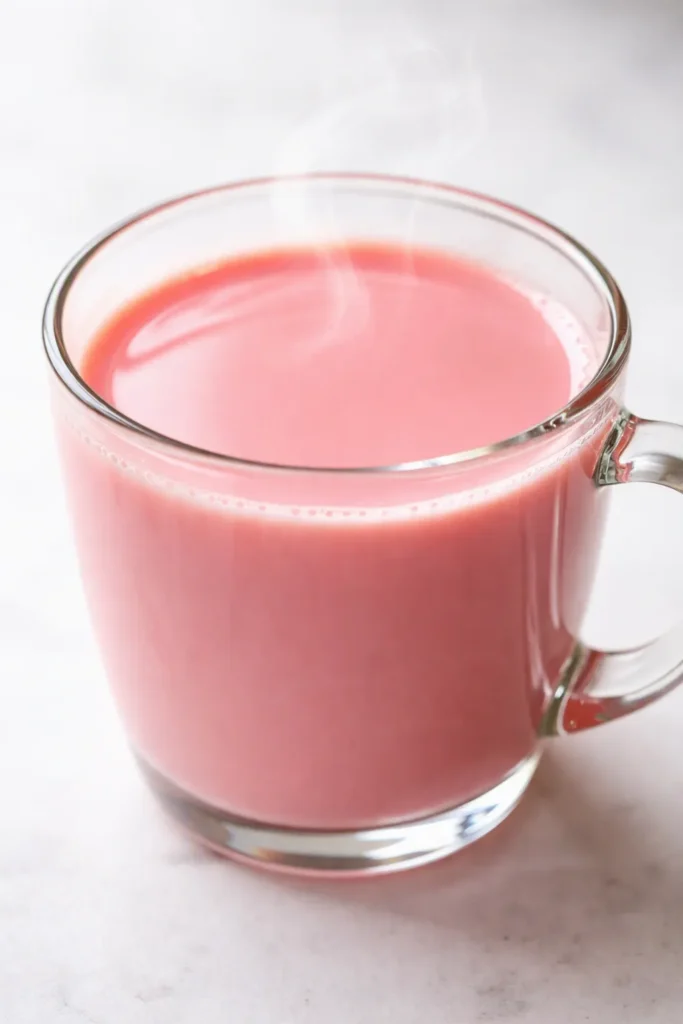
Every pink chai recipe I tried for a whole year came out brown. Not a promising brown — just ordinary tea that had given up on being special. Then my friend Rukshana, who grew up on this in Kashmir, watched me make a batch and laughed. Not a mean laugh. The “oh honey, you’re missing the whole point” laugh. The point, it turned out, was a half-teaspoon of baking soda and a pot boiling hard enough to act like it wants to escape.
This pink chai recipe is the one I’ve made every Sunday since, and it turns that deep, milky rose color every single time. No food coloring anywhere. The pink comes from the tea itself, coaxed out with two old tricks most recipes leave out.
The short version: real Kashmiri noon chai at home — warm, creamy, faintly salty, with cardamom and crushed pistachios on top. It tastes like someone planned the whole morning around you.
I’ve made this forty-something times now, including the batch that stained my cream blouse and the batch that stained the ceiling, which I will not elaborate on.
- Serves: 4 small cups as a breakfast or afternoon tea
- Hands-On Time: 15 min | Total Time: 40 min
- Difficulty: Easy, but it demands attention — the color moves at its own pace
- Cost per serving: about $0.75
- Calories: ~120 per small cup
- Dietary Notes: Naturally gluten-free; dairy-free works with full-fat oat milk (the pink will be softer)
(Photo above: overhead shot of two small glass cups of pink chai on the farmhouse table by the east window, steam catching the morning light, a small bowl of crushed pistachios and a few cardamom pods scattered close by. The chai is that impossible rose color — the one you’re here for.)
Why This Version Actually Turns Pink
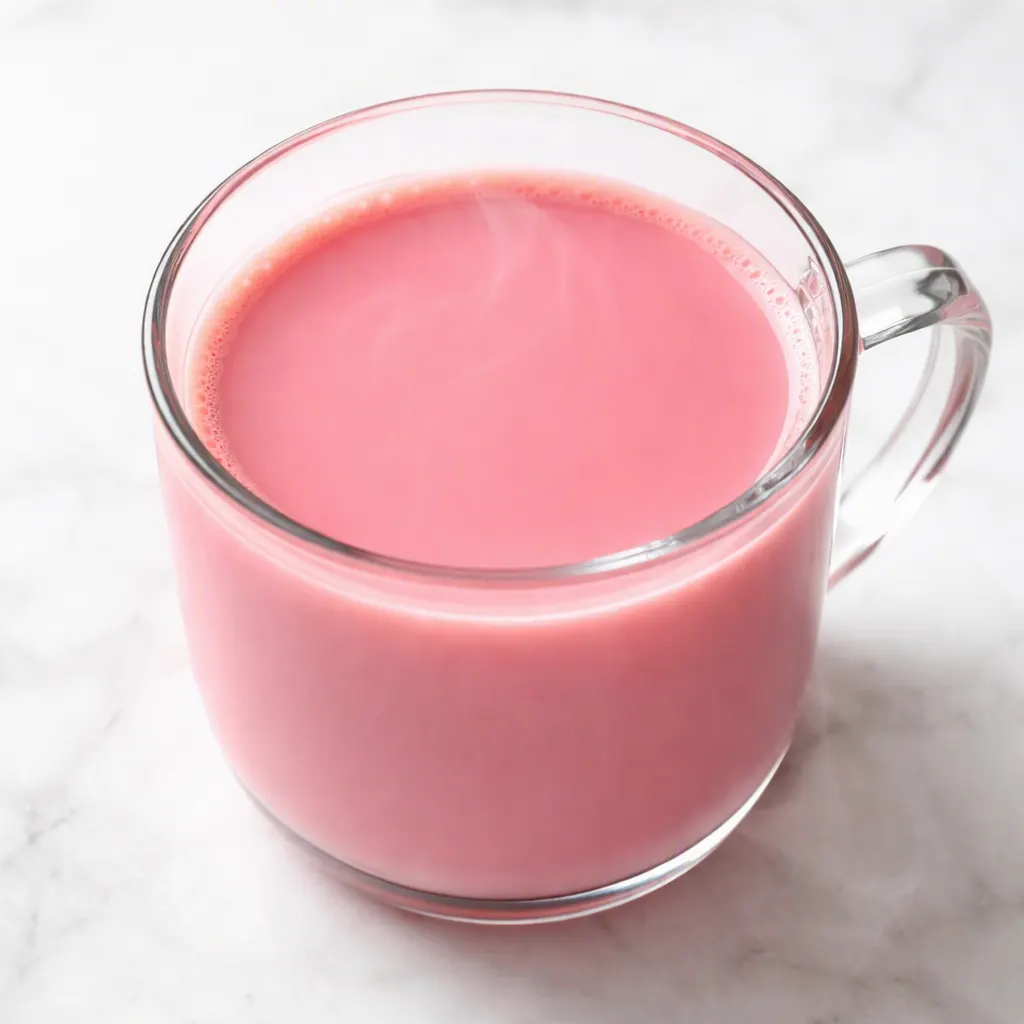
The first time you watch pink chai come together, it feels like a magic trick. The liquid in the pot sits there a deep, almost alarming red, and then the milk goes in and it blushes rose. The trick is not a trick. It’s two things most recipes skip.
The baking soda is the whole game. It doesn’t add color — it pulls the color out of the tea leaves. Half a teaspoon changes what the water does to the leaves, and the leaves respond with a deep brick-red they keep hidden. Skip it and you get beige tea with a memory of pink. I know this because I skipped it three times before Rukshana pointed at my tea and said, “Where is the baking soda?”
The second thing is the cold-water douse. The tea has to be shocked — boiled furiously, knocked back with cold water, then brought to a boil again, four or five times. That back-and-forth pulls the red all the way out. If you add the baking soda and then simmer politely, you’ll get a reddish tea that turns a sad mauve when the milk goes in. The douse is not optional. It is the recipe.
And the milk has to be whole. The color needs the fat to carry it into true pink. Skim milk gives you something anemic — like water that has seen pink from a distance. Whole milk gives you the rose.
Ingredients Worth Talking About
- 2 tablespoons Kashmiri noon chai (green tea) leaves: These leaves carry the pink. They’re a specific green tea that reacts with baking soda. Look for them at an Indian grocery store or online. Rukshana buys hers in three-pound bags. If you can’t find them, gunpowder green tea works as a backup — just not tea bag dust. That’s a different thing and it will not cooperate.
- 1/2 teaspoon baking soda: The whole secret. Not a rounding suggestion. Make sure it’s fresh — an open box from 2021 won’t do the job. I keep a tiny jar in my tea drawer now. My husband thinks I’m precious. My husband also used to think pink chai came from a coffee shop.
- 4 cups water, plus 2 cups cold water: Tap is fine. Keep the cold water ready by the stove in a measuring cup — the douse does not wait for you to open the fridge.
- 2 cups whole milk: Not two percent, not skim. The pink lives in the cream. My daughter Nora made it with whole milk for the first time and texted me a photo with one word: OH.
- 3/4 teaspoon fine salt: The “noon” in noon chai means salt. This is a salty tea by design — the salt makes the milk taste round and almost nutty. Warring opinions in our house: Nora adds a spoon of sugar to hers. I take it straight. Rukshana says both ways are legitimate, which is the wisdom of a woman who has watched many guests try their first cup.
- 4-5 green cardamom pods, lightly crushed: The finishing scent. Crush them gently with the side of a knife so the fragrance comes out but the pods stay whole for easy straining. I tried pre-ground cardamom once. Dusty. It made the tea taste dusty. Whole pods are worth the ten extra seconds.
- For serving: crushed pistachios, slivered almonds, sugar: The pistachios make it look like a celebration — they’re traditional. If I’m feeling fancy, I add a pinch of dried rose petals. It is entirely for show and I am not ashamed.
What to Pull Out Before You Start
- A 4-quart saucepan: Bigger than you think you need. This tea wants to boil over — it’s part of its personality.
- A second pot or large glass measuring cup: For the douse and for the high pour, which is coming.
- A long-handled ladle: The foam gets fierce. Keep your hands away from the climb.
- A fine-mesh strainer: Unless you enjoy chewing tea leaves. I strain.
- Small glass cups: Half the show is the color, and glass shows it off.
- A mortar and pestle, or just a knife and board: For crushing the cardamom and nuts. I use the side of a chef’s knife and it works beautifully.
Let’s Make It — Step by Step
This goes at its own pace, which is the point. Read the steps once before you heat anything — the douse will not wait for you.
- Boil the water: Put 4 cups of water in the saucepan and bring it to a rolling boil on medium-high. A rolling boil means the whole surface is alive with bubbles — not just the edges.
- Add the tea and the baking soda: Drop in the leaves and the baking soda. Stand back a little — the water will foam up fast, like a root beer that was just shaken. Stir once. (📸 Photo tip: you want a deep amber foam climbing the sides — thick and alive, not a thin skim. That foam is the tea waking up, and it means the baking soda is working.)
- Douse it with cold water: The moment the foam reaches the top of the pot, pour in about half a cup of cold water. The foam collapses, the pot settles. Let it roar back to a boil, then douse it again. Repeat three to five times, until the liquid has gone from muddy green-brown to deep brick-red. (📸 Photo tip: hold a spoonful up to the light — the tea should look like dark mahogany, almost burgundy, with no green left. Green means it needs more douses.)
- Pour it high: Take the pot off the heat and pour the red tea from high up — two feet at least — into the second pot or measuring cup. Do it over the sink the first time. Pour it back, again from high. Two or three passes. This stirs air into the tea and deepens the color further. Rukshana beats it with a ladle, scooping and pouring from as high as she can manage. I have the ceiling stains to prove I was overambitious once. The two-pot method is more forgiving.
- Add the milk and salt: Set the pot back on medium heat. Pour in the whole milk and the salt, stir once, and don’t look away. Within a minute a rosy bloom appears at the edges of the pot and spreads slowly toward the center. That is the moment you’ll want to just stand there and watch — allow it!
- Simmer gently: Turn the heat to low. You want a murmur, not a roar — if it boils hard, the milk can scald and the pink goes dull. Let it simmer ten to twelve minutes, stirring now and then, until the color is uniform and the chai coats the back of a spoon. You’ll feel it get a little silkier against the spoon, and the smell will shift from mineral tea to something warmer and almost sweet.
- Add the cardamom: Drop in the crushed pods, cover the pot, and let it steep off the heat for five minutes. The cardamom is the last taste on every sip — the warm note that lingers.
- Strain and serve: Strain into small cups, top with crushed pistachios and slivered almonds, and put the sugar on the table. Bring the pot to the table if you want the full effect — the color deserves to be seen.
How I Make This Ahead When Company’s Coming
Pink chai is a ceremony, but it’s also a make-ahead breakfast if you do it right. I like to get the tea base through step 4 on Saturday morning — the deep red stage — and keep it in a glass jar in the fridge. Then Sunday, I just warm the base, add the milk and salt, and watch it turn pink while the biscuits go in the oven.
- Fridge: Finished chai keeps in a covered jar for 3-4 days. Reheat gently on the stove — low heat, stir often. The color deepens overnight; that’s normal, not a mistake.
- Freezer: The tea base (before milk) freezes beautifully for up to a month. Thaw it overnight in the fridge, then add fresh milk and salt. Don’t freeze the milky finished chai — it separates and it’s just sad.
- Reheat: Stovetop, low heat, is the only way this is truly good. The microwave works in a pinch but it’s harsh on the milk — stir every 20 seconds and stop before it boils.
What I Learned After Three Brown Batches
- The baking soda has to be fresh: An old box from the back of the fridge is a different creature — it won’t have the strength to pull the color. A fresh box costs fifty cents. Buy it.
- Boil it hard, not politely: I simmered my first batches because the foam scared me. Simmering gets you nowhere. The tea needs a furious, rolling boil with the foam climbing the pot — that’s the only way the color happens. The cold water keeps it controlled. Let it climb.
- Whole milk is the line I will not cross: I know the fridge might only have two percent. I know oat milk is right there. But the pink comes from fat. The flavor will be fine either way; the color will be a washed-out lavender. Use whole milk the first time, at least, so you know what it’s supposed to look like. And honestly — even if you mess this up a little, it’s still good. I’ve drowned it, I’ve scorched it, and it has always been drinkable. On scorch day it was even memorable.
- Trust the salt before you add sugar: Your instinct will be to sweeten it. Try it salty first — a real sip, not a tiny one. The salt is what lets the cardamom land softly and the milk taste round. Even if you end up adding sugar, and I know Nora does, give the salty version at least one honest cup.
Swaps That Actually Work
- Dairy-free: Full-fat oat milk gives the closest pink — more of a peachy blush than a true rose. Coconut milk works too and turns it almost dessert-like. Almond milk gets weirdly gray; avoid it. My sister-in-law is dairy-free and swears by the oat milk version.
- Sweet pink chai: Some Kashmiri households serve it sweet — sugar stirred in, less salt. If that’s your family’s version, add 2-3 tablespoons of sugar once the milk and salt have melded. Call it dessert tea. No judgment from me, and none from Rukshana.
- Iced pink chai: In a North Carolina July, I still want this color. Make the base ahead, chill it, then pour it over ice with cold whole milk and skip the simmering. It’s more pink tea latte, less ceremony, and it’s my favorite hot-weather trick.
- The fancy version: Add 2-3 saffron threads with the cardamom, and a pinch of dried rose petals for the last minute. It looks like a wedding, which makes sense — in Kashmir, this is often a wedding drink.
- No cardamom? A lightly bruised cinnamon stick in step 7 is a warm, round stand-in. Not the same, but it won’t argue with you.
Questions I Get About Pink Chai All the Time
Q: Why did my chai turn brown instead of pink?
A: Ugh, I’ve been there. The two usual culprits: the baking soda was old or missing, or the tea never hit the deep red stage before the milk went in. The milk can only turn red tea pink — it cannot turn brown tea anything. Check the baking soda, boil the tea hard, douse it four or five times until it’s the color of old bricks. You’ve got this next time.
Q: Can I make this with regular green tea or tea bags?
A: Yes, sort of. Gunpowder green tea is the best substitute — it’s a strong, slightly smoky green tea that reacts well with baking soda. Regular green tea bags will work in a pinch, but the color will be lighter and less dramatic. Loose leaves are the way. I’ve tested this and it works; just manage your expectations on that deep pink.
Q: How long does pink chai last? Can I freeze it?
A: Finished chai keeps in the fridge for 3-4 days in a covered jar. Reheat it gently on the stove and know that the color will deepen overnight — that’s normal. The tea base (before the milk goes in) freezes beautifully for up to a month; the milky finished chai does not, so freeze the base instead. The microwave works for a single cup, though it can make the milk slightly grainy.
Q: What do you serve with pink chai?
A: In Kashmir, it shows up at breakfast and at weddings. At our house, I make it on Sunday mornings with Grandma Marta’s apple cake, or with buttered toast if I’m being honest about how Sundays actually go. My kids like to dunk toast soldiers in it, which Rukshana finds adorable. For a fancier spread, samosas or a cardamom biscotti are perfect.
More Recipes My Family Makes on Repeat
If this one found its way into your kitchen, here are a few others that get the same reaction at our table:
- [INTERNAL LINK PLACEHOLDER: Masala Chai] — the spicier sibling for cold mornings when you want ginger doing the heavy lifting.
- [INTERNAL LINK PLACEHOLDER: Grandma Marta’s Apple Cake] — dense and buttery and exactly what this tea wants to be poured alongside.
- [INTERNAL LINK PLACEHOLDER: Almond Cardamom Biscotti] — twice-baked and made for dunking; they disappear embarrassingly fast.
Pink chai has become my slow-Sunday ritual — the one thing I make without feeling the clock, the color doing its quiet work while the kitchen smells like cardamom and warm milk. That’s what I hope it becomes for you, too: not another thing to make, but the thing you look forward to.
If you try it, drop a comment below — I love hearing how it goes for you! And if someone in your house has Opinions about the salt, I want to hear those too. Tag me on Pinterest so I can see that first rosy cup.
📌 This pink chai recipe turns that milky rose color you’ve seen in photos — save it for your next slow Sunday morning or your first cold-weather weekend.
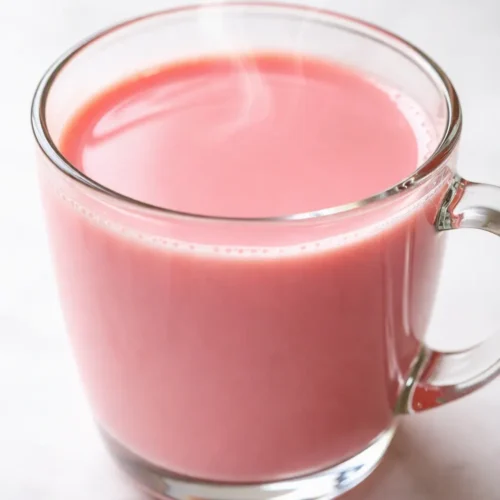
The Pink Chai Recipe That Actually Turns Pink — Kashmiri Noon Chai, the Slow Way
Equipment
- 4-Quart Saucepan
- Second Pot or Large Glass Measuring Cup
- Long-Handled Ladle
- Fine-mesh strainer
- Small Glass Cups
- Chef’s Knife
Ingredients
- 2 tablespoons Kashmiri noon chai (green tea) leaves
- 1/2 teaspoon baking soda
- 4 cups water
- 2 cups cold water
- 2 cups whole milk
- 3/4 teaspoon fine salt
- 4-5 green cardamom pods, lightly crushed
For Serving
- 1/4 cup crushed pistachios
- 2 tablespoons slivered almonds
- to taste sugar
Instructions
- Bring 4 cups of water to a rolling boil in a 4-quart saucepan over medium-high heat.
- Add the tea leaves and baking soda. Stand back a little — the water will foam up fast. Stir once.
- When the foam reaches the top of the pot, pour in about half a cup of cold water. Let it roar back to a boil, then douse again. Repeat 3 to 5 times until the liquid is deep brick-red.
- Take the pot off the heat and pour the red tea from high up — at least two feet — into a second pot or measuring cup. Pour it back, again from high, two or three times.
- Set the pot back on medium heat. Pour in the whole milk and salt, stir once, and watch for a rosy bloom spreading from the edges toward the center.
- Turn the heat to low and simmer gently for 10 to 12 minutes, stirring now and then, until the chai coats the back of a spoon.
- Add the crushed cardamom pods, cover the pot, and steep off the heat for 5 minutes.
- Strain into small cups, top with crushed pistachios and slivered almonds, and serve with sugar on the table.
Notes
Related posts:
 The Slow Cooker Cowboy Casserole That Saves Tired Weeknights (No Soggy Tots Allowed)
 Lemon Garlic Butter Baked Salmon in Foil That’s Ready in 25 Minutes — No Fuss, No Mess
 Moist Chocolate Zucchini Bread That Doesn’t Turn Out Rubbery — Finally
 Creamy Homemade Strawberry Dole Whip (That Tastes Just Like the Real Thing)
 Blueberry Peach Bread That Doesn’t Sink or Turn Mushy — Finally
 Quinoa Chicken Sausage Bowls That Are Ready in 30 Minutes (And Actually Keep Well)